Colonisation of Australia little over 230 years ago brought profound, unprecedented disruption to Aboriginal and Torres Strait Islander peoples and cultures. These impacts are continuing. Mental health disorders, once relatively rare, are now common. Power structures reflect western cultural dominance, and the tools of mental health care reflect western ways of working, including psychiatry, psychology, drugs, restraints and seclusion.
To say this approach is ineffective for Aboriginal people and cultures is an enormous understatement.
For at least 30 years, mainstream mental health services have been told how they need to change so that Aboriginal and Torres Strait Islander people have equitable access to effective care, as is their right. Unfortunately, the series of promises made to Aboriginal and Torres Strait Islander people, through a raft of strategies, frameworks and governance models, have not brought about the changes required. Instead they have resulted in distrust and a worsening of health and its determinants in some areas. This inequality needs to be rectified (Australian Institute of Health and Welfare & National Indigenous Australiains Agency, 2022).
In 2021, NSW Health commissioned Yulang to develop cultural models of mental health and wellbeing care for Aboriginal and Torres Strait Islander people in NSW. Our work was underpinned by Aboriginal cultural principles and knowledges, the rights of Indigenous peoples, an examination of NSW Health policy settings and legislative requirements, an audit of Australian best practice and consultation with 130 consumers, carers, service providers, NSW Health staff and others, of whom 91 are Aboriginal.
We also worked with the set of principles on which the NSW Aboriginal mental health strategy 2020-2025 is based, being:
1. Trust and cultural respect are fundamental
2. The cultural values and traditions of Aboriginal communities are recognised
3. Aboriginal people’s holistic understanding of health encompasses mental, physical, emotional, social, cultural and spiritual health
4. The valuable and unique role of Aboriginal Community Controlled Health Organisations (ACCHOs) is recognised
5. Aboriginal people participate at all levels of health service delivery and management
6. Partnerships with Aboriginal communities through ACCHOs and the Aboriginal Health & Medical Research Council of NSW (AH&MRC) are supported
7. The social determinants that lead to health disparities for many Aboriginal people are addressed at an individual and systemic level
8. Practices and policies are respectful, inclusive and culturally safe for Aboriginal consumers, carers and staff
9. Genuine partnerships exist between service providers and Aboriginal consumers, carers and communities to support the design, delivery and evaluation of mental health services.
We reviewed cultural models of care in other states and territories, mental health and wellbeing strategies and frameworks, cultural safety frameworks and human rights frameworks. We consulted widely, particularly among Aboriginal health and mental health staff, people with lived experience, carers, ACCHOs, Aboriginal and Torres Strait Islanders service providers and peak bodies, NSW pillars, national experts in mental health and service provision, professional associations and people associated with prisons, emergency departments, police, intellectual disability, eating disorders and more. We acknowledge the strength and generosity of the many Aboriginal and Torres Strait Islander people and non-Indigenous people we spoke to.
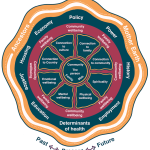
We based our work on the Aboriginal and Torres Strait Islander views of health and of social and emotional wellbeing – see below. To experience health, Aboriginal people are closely connected to family, to community and to mob, with a sense of their identity as an Aboriginal person. Health and wellbeing are influenced by connection to Country, to culture, to family and to community. They are also influenced by spirituality and by physical, mental and emotional wellbeing. Issues such as power, policy, justice and education have direct and indirect influences. And embracing it all are the strong ties between ancestors, creation spirits and other beings and Mother Earth. Mental health is part of this, but only a part.
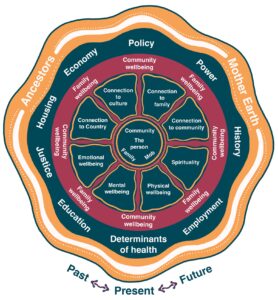
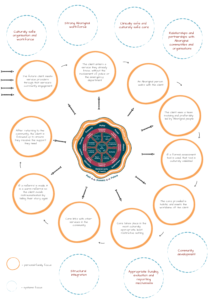
That broad view of health and wellbeing directly influence the client journey, in which:
- the person already knows the service, because that service has engaged with community
- the person enters the service with the support of family, community and health services, without needing police or the emergency department
- an Aboriginal person walks with the person throughout their journey
- the person sees a team involving, and preferably led by, Aboriginal people
- if a formal assessment tool is used, that tool is culturally validated
- the care provided is holistic and meets the worldview of the client
- care takes place in the most culturally appropriate, least restrictive, place
- care links with other services in the community
- if a referral is made, it is a warm referral
- after returning to the community, the client is followed up to ensure they receive the support they need.
To achieve this, work at a systems level is required. The most important building block of the Aboriginal mental health and being model of care is a culturally safe organisation and workplace with Aboriginal leadership. Others are shown below.
This report is being used is many parts of NSW to improve government mental health and wellbeing services for Aboriginal people.
Suggested citation
Williams, M., Ragg., & Bulman, J. (2022). Aboriginal mental health and wellbeing model of care. NSW Health: Commerical-in-confidence.

Our projects